SPEROW
Hysteroscopy

Hysteroscopy

A complete, patient-centered guide to hysteroscopy — indications, procedure types, recovery milestones, risks, insurance coverage, and costs in India.

Medically Reviewed ByDr. N V Gowthami MullangiLast updated: 16 July 2026
  • Surgery Name

    Hysteroscopy

  • Specialty

    Gynecology

  • Department

    Obstetrics & Gynecology

  • Duration

    15–60 Minutes

  • Hospital Stay

    Usually Daycare Procedure (Same-Day Discharge)

  • Recovery Time

    2–14 Days for Most Patients

  • Anesthesia

    Local, Regional, Sedation, or General Anesthesia

  • Insurance Coverage

    Usually Covered if Medically Necessary

  • Cost Range in Hyderabad

    ₹20,000 – ₹75,000

  • Success Rate

    Generally Above 90% for Diagnosis and Treatment of Suitable Conditions

45+

Cases Reported Annually in Hyderabad

(per 1 Lakh Population)

Free

Free Second Opinion

Get connected with a trusted doctor for an expert second opinion through our care team—at no cost.

Get Your Free Consultation

Clinical Indications for a Hysteroscopy

A hysteroscopy is typically advised when a patient presents with unresolved pelvic symptoms or reproductive challenges that require high-precision internal assessment:

1. Dysfunctional Bleeding Signifiers

  • Menorrhagia, abnormally heavy or prolonged menstrual bleeding that disrupts regular routines
  • Oligomenorrhea, highly irregular menstrual cycles with unpredictable flow variations
  • Intermenstrual tracking, unexpected bleeding or spotting occurring actively between defined periods
  • Postmenopausal bleeding, any form of fresh vaginal bleeding occurring long after menopause, requiring prompt investigation

2. Reproductive & Structural Indicators

  • Primary/Secondary infertility, difficulty getting pregnant despite regular unassisted attempts
  • Recurrent loss, recurrent miscarriages that necessitate a structural look at the cavity lining
  • Intractable pain, unexplained pelvic pain or cramping unrelated to clear external anomalies

3. Radiographic Discrepancies

  • Intrauterine filling defects, abnormal ultrasound or scan findings localized inside the uterine lining walls
  • Suspected growths, strong diagnostic suspicion of hidden endometrial polyps or submucosal fibroids
  • Retained tissue profiles, retained products of conception remaining behind after a miscarriage or delivery event

Hysteroscopy
View full size

Common Conditions Treated

1. Benign Intrauterine Growths

  • Endometrial polyps, soft vascular growths on the inner lining that trigger heavy bleeding and spot anomalies
  • Submucosal fibroids, benign muscular tumors that project directly into the cavity, distorting its shape
  • Abnormal uterine bleeding, AUB conditions driven by localized cellular changes inside the endometrium lining layers

2. Structural & Reproductive Pathologies

  • Asherman's syndrome, dense uterine adhesions or scar tissue bands that bond cavity walls together
  • Septate uterus, a congenital tissue wedge splitting the uterus down the center, heavily associated with recurrent early pregnancy losses
  • Uterine infertility factors, localized architectural abnormalities blocking normal gamete migration or embryonic nesting
  • Retained tissue products, products of conception remaining attached to the internal muscle wall after pregnancy resolution
  • Endometrial hyperplasia staging, abnormal thickening of the uterine lining demanding directed visualization and testing checks
  • Postmenopausal anomalies, comprehensive endo-cavity mapping to verify unexpected postmenopausal bleeding sources
Hysteroscopy
View full size

What Is Happening Inside Your Body?

The uterus is a muscular reproductive organ lined internally by a dedicated responsive tissue layer called the endometrium. This lining layer naturally expands, transitions, and sloughs off each month during standard menstruation cycles.

Sometimes, abnormal localized growths, fibrous scar tissue planes, congenital septums, or stubborn unviable tissue strings collect inside the cavity, preventing the organ from contracting effectively or disrupting the smooth tracking of embryo implantation.

Standard ultrasound scans help pick up general signs of these abnormalities, but blind procedures risk missing small pathologies or leaving behind marginal edges. A hysteroscopy solves this bottleneck by providing a highly clear, high-definition direct view, allowing doctors to diagnose anomalies confidently and address them with targeted precision during the same session.

Hysteroscopy
View full size

The Hyderabad Lifestyle Matrix: Why Hysteroscopy Is Increasingly Performed

In urban Hyderabad, hysteroscopy is increasingly performed for the diagnosis and treatment of abnormal uterine bleeding, endometrial polyps, submucosal fibroids, infertility, recurrent pregnancy loss, and retained intrauterine tissue. Greater awareness of minimally invasive gynecological procedures and improved access to advanced women's healthcare have enabled earlier diagnosis and same-day treatment of many uterine conditions.

1. Early Evaluation of Uterine Disorders

Many uterine conditions present with symptoms such as heavy menstrual bleeding, irregular periods, infertility, or recurrent miscarriages. Early gynecological assessment allows direct visualization of the uterine cavity and enables timely treatment before symptoms become more severe.

Delayed Consultation for Abnormal Uterine Bleeding

The Data: Many women initially attribute heavy or irregular menstrual bleeding to hormonal changes or stress and postpone specialist consultation. In Hyderabad, increasing awareness has improved access to gynecological care, but delayed evaluation of persistent symptoms remains common among women with busy lifestyles or limited awareness of available minimally invasive procedures.

The Hysteroscopy Link: Persistent abnormal bleeding often requires direct visualization of the uterine cavity to diagnose conditions such as endometrial polyps, submucosal fibroids, adhesions, or endometrial abnormalities, making hysteroscopy both a valuable diagnostic and therapeutic procedure.

Growing Access to Minimally Invasive Gynecological Care

The Data: Hyderabad has witnessed significant growth in tertiary gynecology centres offering office hysteroscopy, operative hysteroscopy, fertility services, and advanced endoscopic surgery. Many uterine conditions can now be diagnosed and treated during a single minimally invasive procedure without requiring open surgery.

The Hysteroscopy Link: Improved access to hysteroscopic technology allows earlier diagnosis and treatment of intrauterine pathology, reducing hospital stay, minimizing recovery time, and improving reproductive outcomes for appropriately selected patients.

2. Access to Hysteroscopy Services in Hyderabad

MetricHyderabad / Telangana ContextImpact on Hysteroscopy Care
Advanced Gynecology CentresMajor government and private hospitals offer diagnostic and operative hysteroscopy with experienced gynecologic endoscopic surgeons.Provides timely diagnosis and minimally invasive treatment for common intrauterine conditions.
Office Hysteroscopy AvailabilityMany tertiary hospitals and fertility centres now perform office hysteroscopy without the need for hospital admission in selected patients.Enables faster diagnosis with reduced discomfort, shorter recovery, and lower healthcare costs.
Fertility & Reproductive Medicine ServicesIntegrated fertility centres routinely utilize hysteroscopy during infertility evaluation and recurrent pregnancy loss assessment.Improves identification and treatment of uterine abnormalities that may affect fertility and pregnancy outcomes.
Day-Care Endoscopic ProceduresMost diagnostic and operative hysteroscopy procedures are performed as same-day surgeries with rapid discharge.Allows early return to normal activities while minimizing hospitalization.
Health Insurance CoverageMedically indicated hysteroscopy is commonly covered under private insurance and eligible government health schemes.Improves affordability and access to minimally invasive uterine diagnosis and treatment.

What Causes These Endometrial Anomalies?

The internal structural anomalies that necessitate a diagnostic or operative hysteroscopy are typically triggered by specific underlying paths:

  • Hormonal surges, unregulated estrogen levels stimulate focal tissue sites to expand rapidly, forming polyps or leiomyomas
  • Post-procedural scarring, prior blind curettage or clinical infections can scar the sensitive muscle walls, developing dense fibrous bands
  • Congenital variations, embryonic development variations can leave an avascular muscular septum partitioning the central cavity space

What Is Hysteroscopy?

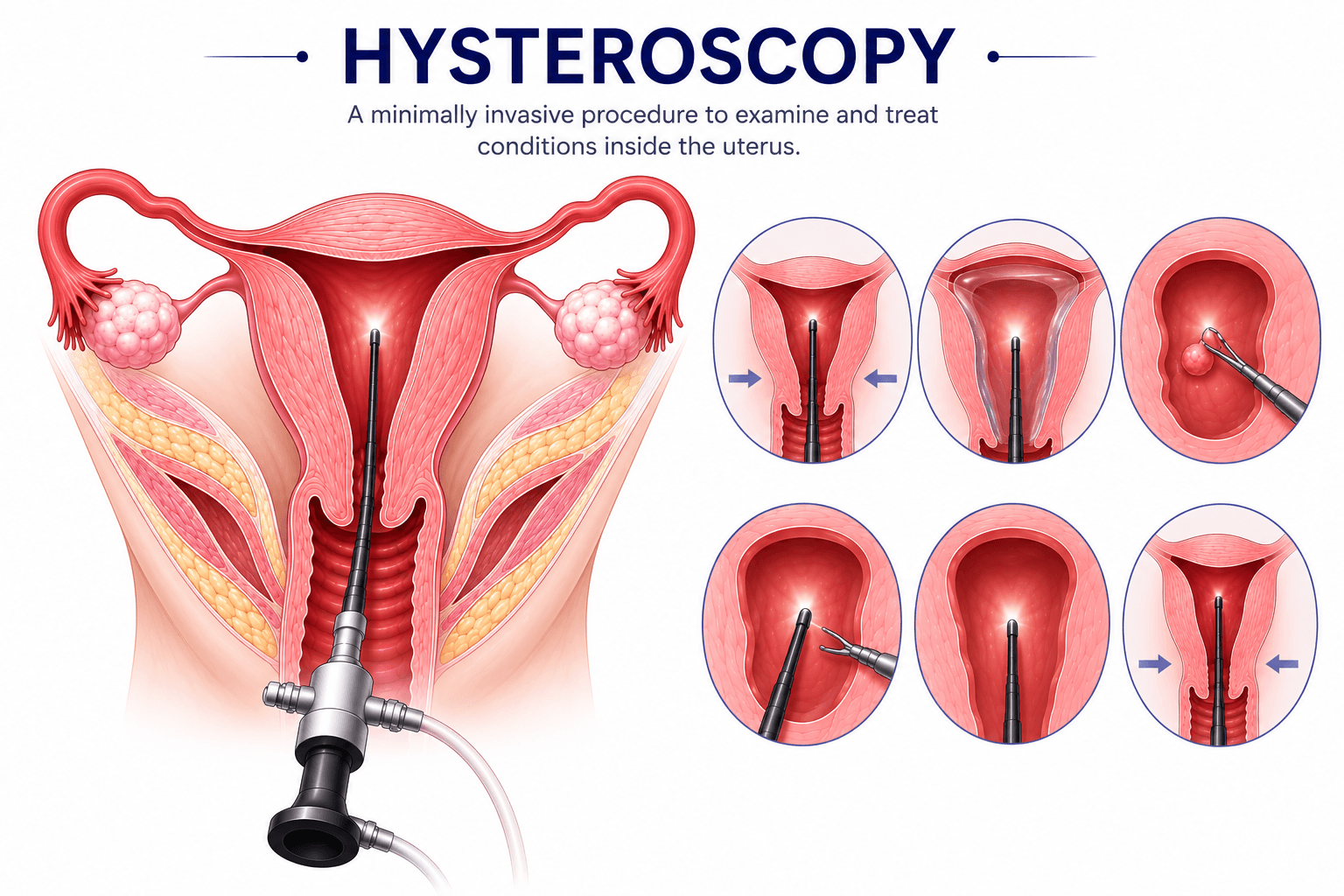
Hysteroscopy is an advanced, minimally invasive gynaecological intervention executed to carefully view the internal architecture of the uterine cavity.

By inserting an ultra-thin, lighted camera console called a hysteroscope gently through the natural vaginal track and cervix, surgeons gain comprehensive visual mastery of the internal environment. Because this approach leverages natural openings, it eliminates the need for any external skin cuts or sutures.

The procedure maps out excellent recovery benchmarks across five core operational priorities: rapidly confirming obscure abnormal bleeding sources, mapping out hidden blocks during comprehensive infertility screening, clearing structural lining barriers like hyperplastic polyps or submucosal fibroid nodes, severing restrictive scar tissue matrices safely, and correcting deep congenital septum errors.

Benefits of Hysteroscopy Surgery

  • Complete absence of external abdominal cuts or surgical scarring
  • Highly localized, minimally invasive procedure model
  • Rapid postoperative recovery and brief down-time track
  • Real-time, clear direct visualization of the deep uterine environment
  • Exceptional diagnostic accuracy compared to blind testing tracks
  • Simultaneous find-and-fix treatment capability in a single procedure
  • Complete preservation of the uterus muscle layers for fertility goals
  • Excellent long-term relief from heavy bleeding or tracking period pain
  • Saves the patient from requiring far more invasive open surgeries later
  • Brief daycare stay format with convenient same-day discharge
Hysteroscopy
View full size

Do You Really Need Surgery?

A specialist will advise a hysteroscopy when pelvic imaging clearly identifies anomalous filling defects inside the cavity, heavy bleeding patterns resist medical management lines, advanced fertility screening requires direct lining evaluation, or recurrent early losses demand a complete architectural review.

Comparison of Different Treatment Options

TreatmentEffectivenessRecoveryHospital StayCostRecurrence RiskFertility PreservationLong-Term Outcome
MedicationsModerateImmediateNoneLowModerateYesVariable
ObservationVariableNoneNoneLowHighYesDepends on condition
Diagnostic HysteroscopyHigh Diagnostic Accuracy1–2 DaysDaycareModerateDepends on conditionYesExcellent
Operative HysteroscopyHighFew DaysDaycareModerateLow-ModerateUsually YesExcellent
HysterectomyDefinitive4–8 Weeks2–5 DaysHighVery LowNoDefinitive

Doctor's Recommendation

Gynaecologists favor hysteroscopy because its micro-visual access eliminates diagnostic guesswork. It allows the clinician to map the landscape clearly and treat structural issues during the same procedural timeline, maintaining structural safety for future pregnancy goals.

Types of Procedures Available

Hysteroscopic procedures are categorized based on whether the primary focus is investigative mapping, clinic-room intervention, or targeted operating room tissue removal:

  • Diagnostic hysteroscopy, focused entirely on evaluating the cavity architecture using a thin diagnostic lens without removing tissue
  • Operative hysteroscopy, utilizes specialized micro-shears or electrosurgical loops passing through the frame channel to correct structural pathologies
  • Office hysteroscopy, a rapid, walk-in diagnostic review completed right in the clinic consultation room with minimal or no local numbing needed
  • Hysteroscopic polypectomy, targeted excision where endometrial polyps are isolated and snipped cleanly away from their tissue base
  • Hysteroscopic myomectomy, surgical shaving or removal of deep submucosal fibroids protruding into the open cavity interior

Preparing for Surgery

Standard tests required to verify baseline procedural safety include comprehensive blood panels, a pre-procedure pregnancy test, high-resolution ultrasound mapping, cardiorespiratory or ECG checks if indicated, and specialized uterine lining biopsies in select cases.

What Happens on Surgery Day?

  • Completing the hospital registration and checking into your daycare block
  • Detailed clinical review of your medical history file and active vitals tracking
  • Verification and signing of the procedural consent paperwork
  • Setting up a standard IV portal line for surgical medications and antibiotics
  • Preoperative anesthesia review in the daycare holding bay

Before vs After Surgery

Before SurgeryAfter Surgery
Heavy bleeding.Improved bleeding control.
Irregular periods.Accurate diagnosis.
Infertility concerns.Better fertility outcomes in selected patients.
Recurrent miscarriages.Removal of abnormal tissue.
Unexplained uterine abnormalities.Relief of symptoms.
Anxiety due to uncertain diagnosis.Improved quality of life.
Hysteroscopy
View full size

How Is the Surgery Performed?

  1. Step 1

    Anaesthesia and Preparation

    The patient receives anaesthesia or sedation and the vaginal area is cleaned with antiseptic solution.

    Patient receives anesthesia or sedation.

    Vaginal area is cleaned with antiseptic solution.

  2. Step 2

    Insertion and Uterine Expansion

    The hysteroscope is inserted through the vagina, the cervix is gently accessed, and sterile fluid expands the uterus for better visibility.

    Hysteroscope is inserted through the vagina.

    The cervix is gently accessed.

    Sterile fluid expands the uterus for better visibility.

  3. Step 3

    Inspection, Treatment and Sampling

    The uterine cavity is carefully inspected; polyps, fibroids, scar tissue, or septa may be removed and tissue samples collected if necessary.

    The uterine cavity is carefully inspected.

    Polyps, fibroids, scar tissue, or septa may be removed if necessary.

    Tissue samples may be collected.

  4. Step 4

    Completion and Recovery

    The instruments are removed and the patient is transferred to recovery.

    Instruments are removed.

    Patient is transferred to recovery.

Duration: Most procedures take approximately 15–60 minutes.

Hysteroscopy
View full size

Expert Guidance, Every Step of the Way

Our dedicated care coordinators are here to answer your questions and guide you through every stage of your treatment.

Talk to Our Experts

Possible Risks and Complications

Like any clinical pelvic intervention, hysteroscopy is highly secure but carries specific manageable risk layers:

ComplicationFrequency
Mild crampingCommon
Light vaginal bleedingCommon
InfectionUncommon
Cervical injuryRare
Uterine perforationRare
Excessive bleedingRare
Fluid overloadRare
Anesthesia complicationsRare
Need for repeat procedureUncommon

1. Common Post-Procedural Realities

  • Mild cramps, minor, period-like uterine contractions that settle within a few hours
  • Temporary spotting, light vaginal blood discharge or pink tracking lasting a few days

2. Rare Operative Complications

  • Uterine perforation, an accidental tiny tear in the thin uterine muscle, typically requiring simple monitoring
  • Pelvic infection, microscopic introduction of pathogens into the cavity, safely cleared using targeted antibiotics
  • Heavy bleeding, persistent vascular loss from raw tissue beds, managed easily with simple clinical measures

3. Anesthesia Secondary Effects

  • Sedation hypersensitivity, mild allergic drug responses or localized skin flares handled instantly by care teams
  • Post-op nausea, transient stomach upset or grogginess as sedation compounds leave the bloodstream
Hysteroscopy
View full size

Cost of Surgery in India

Estimated Cost in Hyderabad

Hospital TypeCost Range
Small Hospital₹15,000 – ₹35,000
Mid-Sized Hospital₹30,000 – ₹60,000
Corporate Hospital₹50,000 – ₹1,00,000+

What Does Cost Usually Include?

  • Surgeon fee
  • Operation theatre charges
  • Anesthesia charges
  • Nursing care
  • Daycare admission
  • Basic medications

Additional Charges May Include

  • Laboratory tests
  • Biopsy analysis
  • Advanced imaging
  • Additional procedures
  • Extended hospital stay
  • Management of complications

Is It Covered By Insurance?

Many health insurance plans cover hysteroscopy when medically necessary.

Coverage often depends on:

  • Diagnosis
  • Policy terms
  • Waiting period completion
  • Pre-authorization approval

Coverage Conditions:

  • Doctor recommendation
  • Medical necessity documentation

Pre-Authorization: May be required for planned procedures.

Waiting Periods: Applicable in some policies, especially for pre-existing conditions.

Exclusions: Cosmetic or non-medically necessary procedures are usually excluded.

Recovery Timeline & Clinical Benchmarks

TimelineWhat Patients Typically Experience
Day 1Mild lower stomach cramps, light spotting trailing off, same-day discharge home to rest.
Week 1Gradual symptom resolution; normal office tasks and light mobility resume cleanly.
Week 2Complete clearing of internal tissue beds; return to full normal personal routines.
Month 1Comprehensive clinical healing across internal tissue walls; standard cycles normalize.
Month 3Complete long-term evaluation of surgical success and fertility optimization parameters.

Postoperative Care Protocols

Inpatient tracking: Post-op care centers around tracking vital sign changes (blood pressure, heart rates), assessing active spot-bleeding, and charting local pain metrics smoothly.

Pain relief: Providing targeted anti-inflammatory drugs and mild analgesics to ensure baseline pelvic comfort before checkout.

Follow-Up Scheduled Reviews

A standard clinical review is typically scheduled 1 to 2 weeks post-procedure. This milestone session ensures the cavity wall is contracting properly, clarifies any bioptic path lab findings, and defines appropriate timelines to safely resume conception planning.

Warning Signs After Surgery

Serious hysteroscopic complications are exceptionally rare. Contact your dedicated care team or present to the emergency room immediately if you note any of these acute indicators:

  1. Fever spikes developing above 100.4°F (38°C).
  2. Acute, worsening abdominal cramps or severe deep pelvic pain.
  3. Heavy bright-red vaginal bleeding that fully saturates a standard sanitary pad within an hour.
  4. Foul-smelling, thick, or purulent vaginal discharge.
  5. Sudden waves of dizziness, cold syncopes, or fainting spells.
  6. Persistent, unresolved vomiting lasting over 24 hours.
  7. Sudden breathing difficulty, shortness of breath, or sharp chest pain.
Hysteroscopy
View full size

Questions to Ask Your Surgeon

  1. Why do I need hysteroscopy?
  2. Is this diagnostic or operative hysteroscopy?
  3. What condition do you suspect?
  4. Are there alternatives?
  5. What are the risks in my case?
  6. Will tissue be sent for biopsy?
  7. How long will recovery take?
  8. When can I return to work?
  9. Will fertility be affected?
  10. Can this improve my chances of pregnancy?
  11. What type of anesthesia will be used?
  12. What symptoms should prompt urgent medical attention?

Frequently Asked Questions

Is hysteroscopy painful?

Most patients experience only mild cramping. Anesthesia or sedation is often used.

Is hysteroscopy a major surgery?

No. It is generally considered a minimally invasive procedure.

Will I need stitches?

No external stitches are usually required.

How long does the procedure take?

Usually 15–60 minutes.

Can I go home the same day?

Yes, most patients are discharged on the same day.

How long will bleeding last?

Light spotting may continue for a few days.

When can I return to work?

Many patients return within 1–3 days.

Can hysteroscopy improve fertility?

It may improve fertility when uterine abnormalities are contributing to infertility.

Can polyps be removed during hysteroscopy?

Yes, polyps are commonly removed during operative hysteroscopy.

Can fibroids be removed during hysteroscopy?

Certain fibroids inside the uterine cavity can be removed.

What is the success rate?

Success rates are generally high when treating appropriate conditions.

Is insurance coverage available?

Many medically necessary procedures are covered.

Can I become pregnant again after hysteroscopy?

Many women can conceive after recovery if fertility factors are favorable.

How soon can I exercise?

Light activity can begin early; strenuous exercise should wait until medical clearance.

When can I travel?

Usually within a few days if recovery is uncomplicated.

Can symptoms return?

Some conditions, such as polyps or fibroids, may recur.

Is anesthesia always required?

Not always. Some office procedures require little or no anesthesia.

What if abnormalities are found?

Treatment may be performed immediately or planned later depending on findings.

Will I have scars?

No external scars are usually created.

How soon can I try for pregnancy?

Your doctor will provide individualized guidance based on the condition treated.

Recent Clinical Studies Redefining Hysteroscopy

Recent international evidence has established hysteroscopy as the gold standard for diagnosing and treating many intrauterine conditions. Contemporary guidelines emphasize office hysteroscopy, minimally invasive operative techniques, and individualized patient selection for managing abnormal uterine bleeding, infertility, recurrent pregnancy loss, retained products of conception, and endometrial pathology. Advances in hysteroscopic technology have also improved procedural safety, patient comfort, and same-day recovery.

Study / GuidelineCore Metric SettledDirect Impact on Surgical PracticeLink to Study / Summary
AAGL Practice Report – Office Hysteroscopy (2023 Update)Performing hysteroscopy directly in the doctor's office using ultra-thin cameras is highly accurate, safe, and significantly more comfortable for patients compared to old-school blind testing.Allows patients to get an instant, clear look inside the uterus without needing major operating room anesthesia, dropping recovery times to just a few hours.https://aagl.org/wp-content/uploads/2023/05/aagl-patient-information-sheets-all.pdf
FIGO Recommendations for Abnormal Uterine Bleeding Evaluation (2023)Standardized the globally accepted PALM-COEIN roadmap to accurately pinpoint whether heavy or irregular periods are caused by structural issues (like polyps or fibroids) or non-structural hormonal shifts.Ensures patients receive a precise, tailored diagnosis rather than generic treatments, making a targeted hysteroscopy the gold-standard step to find and fix the exact cause of bleeding.https://pubmed.ncbi.nlm.nih.gov/37538019/
Systematic Review of Office vs Operating Room Hysteroscopy (2024)A comprehensive analysis confirming that shifting routine checkups and small polyps/fibroid removals from the hospital operating room to an office procedure room cuts medical bills drastically while maintaining identical success and safety rates.Accelerated the shift toward convenient, walk-in/walk-out uterus mappings, saving patients from painful hospital stays, heavy sedation side-effects, and unnecessary workplace downtime.https://pmc.ncbi.nlm.nih.gov/articles/PMC10952771/

Find the Right Specialist

A hysteroscopy is typically performed by a gynecologist, particularly one trained in minimally invasive gynecologic procedures. SPEROW streamlines your patient path by coordinating with elite, high-volume endoscopic consultants across premium daycare structures, ensuring fast healthy recoveries and cashless tracking help.

Find a Surgeon You Can Trust

We'll connect you with an experienced specialist who matches your condition, treatment needs, and preferences.

Find the Right Surgeon

Free Consultation

Free

Get connected with a trusted doctor for an expert second opinion through our care team.

No Cost Expert Guidance · Coordinated Care · Personalized Support