 SPEROW
Total Knee Replacement (TKR) Surgery
Total Knee Replacement is a common procedure to resurface a severely damaged or arthritic knee joint, relieving chronic pain and making daily movement easier. During the surgery, the doctor removes worn-out bone and cartilage from the ends of your thighbone and shinbone, replacing them with smooth, high-grade metal and durable plastic components. This acts as a brand-new cushion for the joint, restoring stability, eliminating bone-on-bone friction, and helping you walk, climb stairs, and stay active comfortably again.
Total Knee Replacement (TKR) Surgery
Total Knee Replacement is a common procedure to resurface a severely damaged or arthritic knee joint, relieving chronic pain and making daily movement easier. During the surgery, the doctor removes worn-out bone and cartilage from the ends of your thighbone and shinbone, replacing them with smooth, high-grade metal and durable plastic components. This acts as a brand-new cushion for the joint, restoring stability, eliminating bone-on-bone friction, and helping you walk, climb stairs, and stay active comfortably again.
Medically Reviewed ByDr Radhakrishna Rao Sagi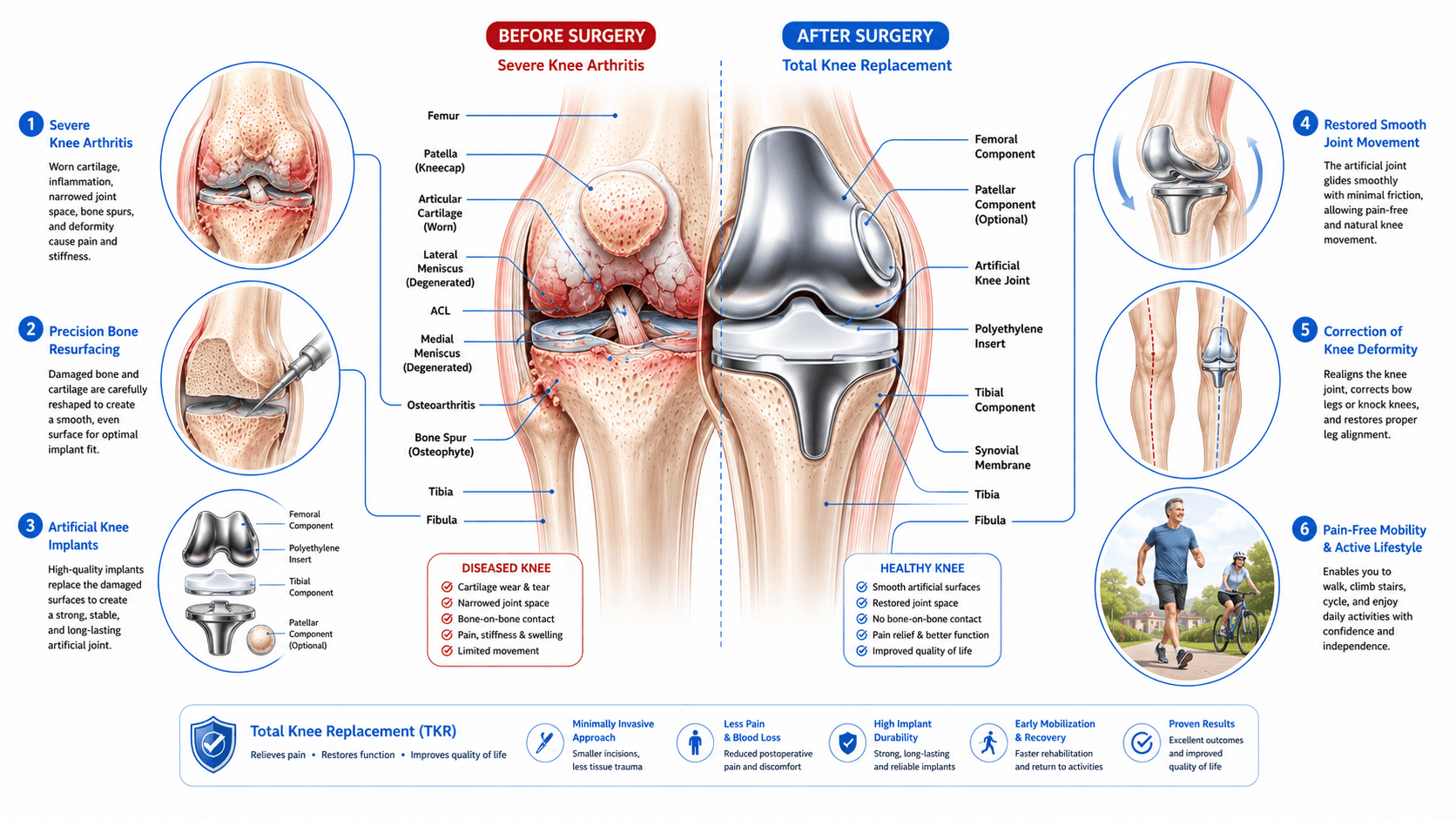
145+
Cases Reported Annually in Hyderabad
(per 1 Lakh Population)
Free Second Opinion
Get connected with a trusted doctor for an expert second opinion through our care team—at no cost.
Symptoms and Signs of Total Knee Replacement
Patients who eventually require Total Knee Replacement often experience symptoms that progressively worsen over several years. The most common warning signs include persistent knee pain during walking, climbing stairs, or standing, pain at rest or during the night, and morning stiffness lasting more than 30 minutes.
- Persistent knee pain during walking, climbing stairs, or standing.
- Pain at rest or during the night that interrupts sleep.
- Morning stiffness lasting more than 30 minutes.
- Swelling that repeatedly returns despite treatment.
- Reduced range of knee movement and grinding, clicking, or creaking sensations (crepitus).
- Bow-legged or knock-kneed deformity, and difficulty sitting, squatting, or getting up from a chair.
- Dependence on walking aids because of pain or instability, and failure of medications, injections, physiotherapy, or weight loss to relieve symptoms.