ACL Reconstruction Surgery
ACL Reconstruction is a surgery to rebuild a major stabilizing tissue (the ACL) inside your knee after it has been torn, often during sports or a sudden twist. Because a fully torn ACL cannot heal on its own, the surgeon removes the damaged tissue and replaces it with a new piece of healthy tissue (called a graft) taken from another part of your leg. This restores strength and stability to the knee joint, preventing it from giving out and helping you get back to active movement.
ACL Reconstruction Surgery
ACL Reconstruction is a surgery to rebuild a major stabilizing tissue (the ACL) inside your knee after it has been torn, often during sports or a sudden twist. Because a fully torn ACL cannot heal on its own, the surgeon removes the damaged tissue and replaces it with a new piece of healthy tissue (called a graft) taken from another part of your leg. This restores strength and stability to the knee joint, preventing it from giving out and helping you get back to active movement.
Medically Reviewed ByDr Radhakrishna Rao Sagi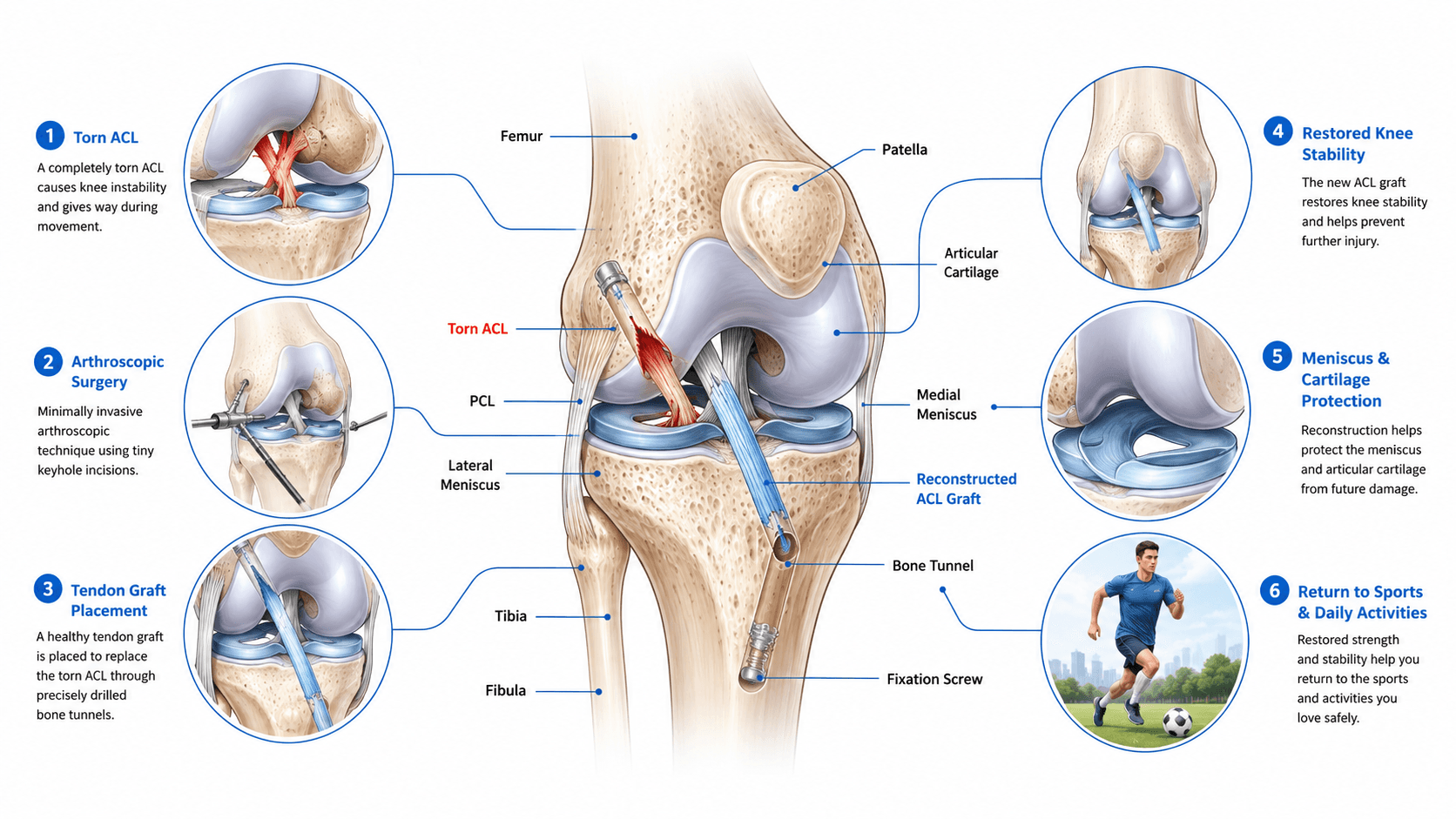
Free Second Opinion
Get connected with a trusted doctor for an expert second opinion through our care team—at no cost.
Symptoms and Signs of ACL Reconstruction
An ACL tear often occurs suddenly during sports or activities involving rapid pivoting, twisting, jumping, or awkward landings. Many patients describe hearing or feeling a distinct "pop" at the time of injury, followed by immediate pain and difficulty bearing weight. Persistent knee instability is the hallmark feature of an ACL tear.
- A loud "pop" at the time of injury, especially during twisting, sudden directional changes, or an awkward landing.
- Immediate knee pain that may limit walking and movement.
- Rapid knee swelling within 2-12 hours due to bleeding inside the joint (hemarthrosis).
- Knee instability or a feeling of "giving way" while walking, climbing stairs, pivoting, or turning quickly.
- Difficulty walking or bearing weight, sometimes requiring crutches in the early stages.
- Reduced range of motion, tenderness around the joint line, and loss of confidence during movement.
- Symptoms of associated injuries such as locking of the knee (suggesting a meniscus tear), clicking or catching, and inability to fully extend the knee.