Arthroscopic Meniscectomy (Meniscus Surgery)
Arthroscopic Meniscectomy is a quick, keyhole knee surgery used to trim or repair a torn meniscus—the flexible piece of rubbery cushion inside your knee joint. The surgeon makes a couple of tiny openings on the knee and uses a miniature camera to see and fix the torn tissue. Because the cuts are very small, there is minimal scarring, and most people recover quickly and get back to walking without pain or catching in the knee.
Arthroscopic Meniscectomy (Meniscus Surgery)
Arthroscopic Meniscectomy is a quick, keyhole knee surgery used to trim or repair a torn meniscus—the flexible piece of rubbery cushion inside your knee joint. The surgeon makes a couple of tiny openings on the knee and uses a miniature camera to see and fix the torn tissue. Because the cuts are very small, there is minimal scarring, and most people recover quickly and get back to walking without pain or catching in the knee.
Medically Reviewed ByDr Radhakrishna Rao Sagi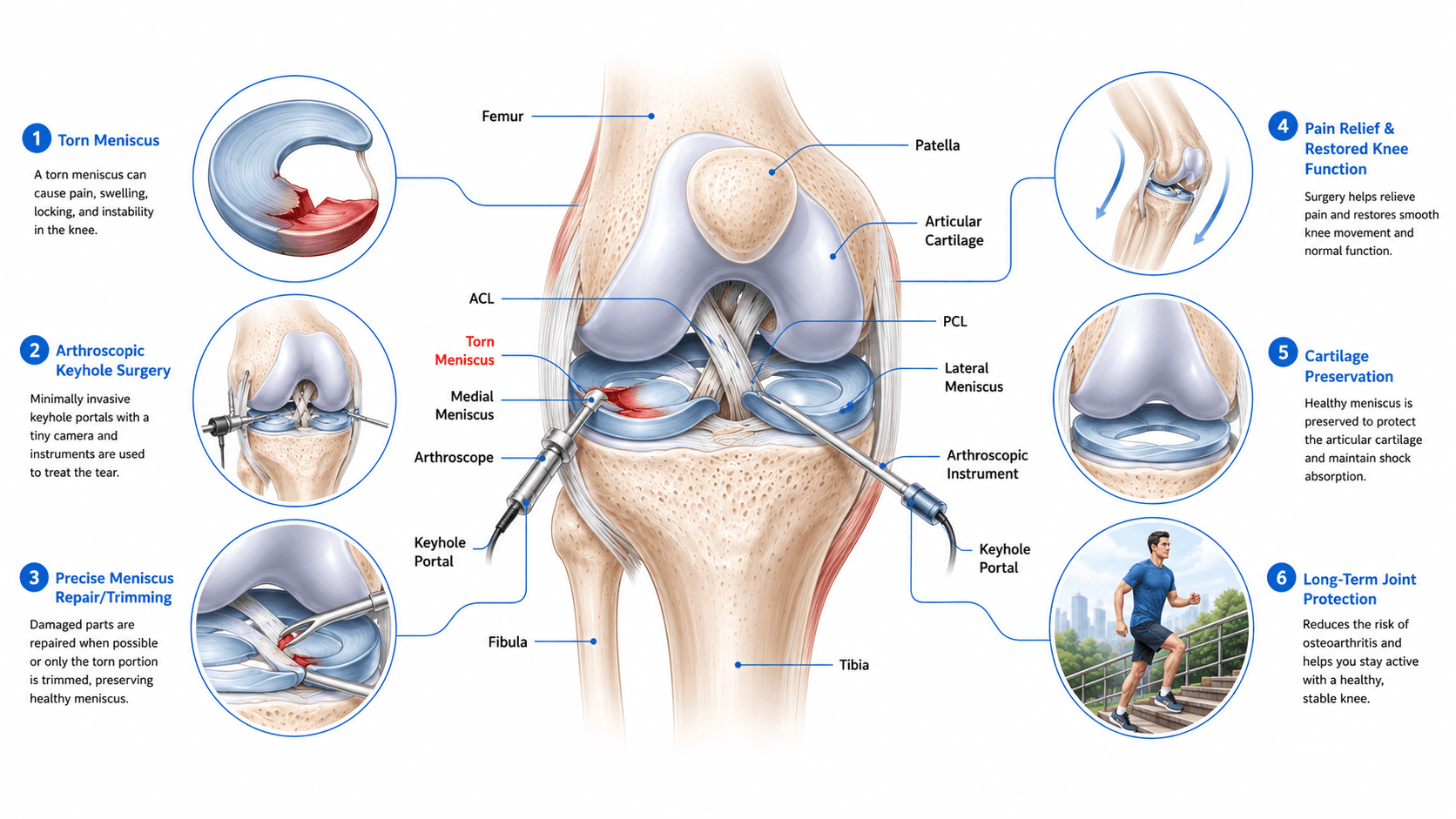
Free Second Opinion
Get connected with a trusted doctor for an expert second opinion through our care team—at no cost.
Symptoms and Signs of Arthroscopic Meniscectomy
Symptoms of a meniscus tear vary with the size, location, and severity of the injury. Some people feel sudden pain immediately after a twisting injury, while others notice discomfort that builds gradually - particularly with age-related degenerative tears. Symptoms may appear right away or develop over several days as swelling and inflammation increase within the knee.
- Knee pain along the inner (medial) or outer (lateral) side, often worse when walking, squatting, climbing stairs, kneeling, or twisting.
- Swelling of the knee, usually developing within several hours or gradually over 24-48 hours.
- Locking of the knee, where a displaced fragment (often from a bucket-handle tear) physically blocks movement - an important sign needing urgent evaluation.
- A catching or clicking sensation as the torn fragment moves between the joint surfaces.
- Difficulty squatting, sitting cross-legged, kneeling, or rising from a seated position.
- Reduced range of motion, stiffness after rest, and joint-line tenderness when pressed.